There are women who still wash and reuse aluminum foil - who smooth it flat on the counter with both hands and fold it back into the drawer even though they could buy a hundred rolls now and never notice the cost - not because they are frugal but because a girl who watched her mother make one sheet last an entire week learned that a woman's worth was measured in what she could make last, and the foil in the drawer at fifty-seven is not thrift but a love letter to a mother who made scarcity look like skill
I caught myself doing it last Thursday.
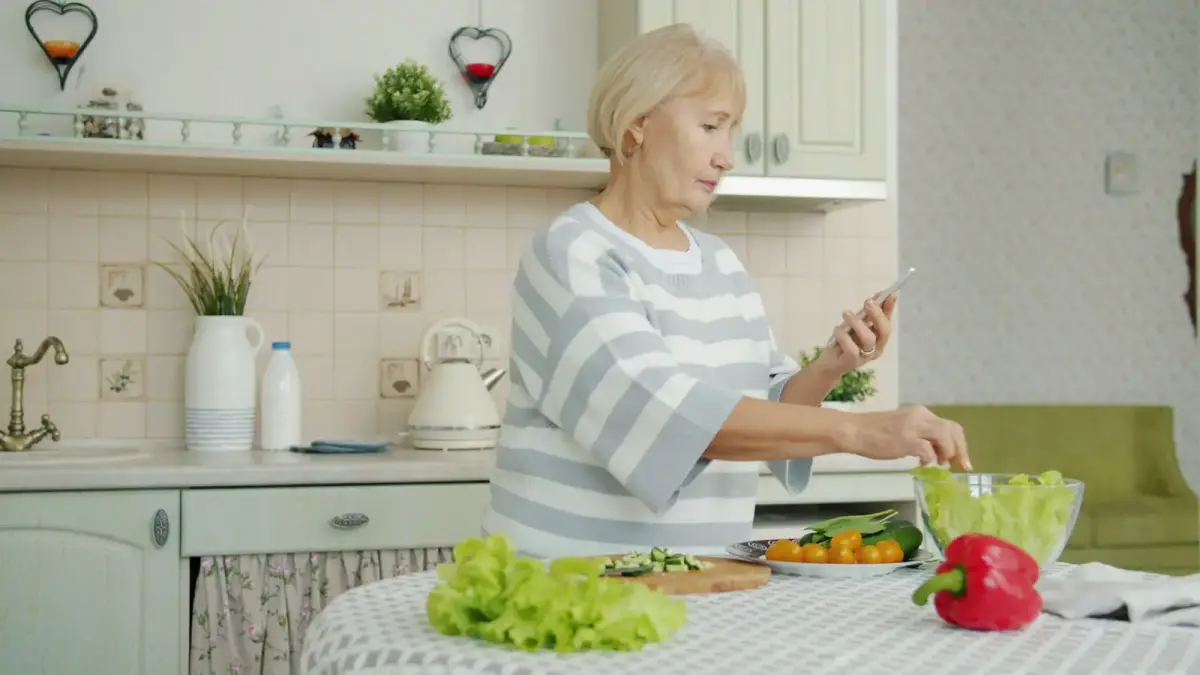
Standing at the sink after dinner, warm water running over a crinkled sheet of aluminum foil, rubbing it gently between my thumb and fingers like I was washing something precious. I smoothed it out on the counter with both palms - pressing the wrinkles flat the way you’d iron a collar before church - then folded it into a neat square and slid it back into the drawer beside the oven mitts.
My daughter watched me from the kitchen doorway. She didn’t say anything. She’s twenty-three and has never once in her life worried about whether there was enough of anything. But she watched my hands move across that sheet of foil the way you watch someone perform a ritual whose origin you don’t understand but whose seriousness you can feel.
I have six rolls of aluminum foil in the pantry. I checked.
I washed that one sheet anyway.
The drawer that held everything twice
My mother had a drawer. Every woman I knew growing up had one. Not a junk drawer - junk drawers belong to people who can afford to throw things away and don’t bother. This was something else entirely.
This was the drawer for things that had already been used once and could be used again.
Wax paper, smoothed flat. Twist ties from bread bags, sorted by length. Rubber bands saved from the newspaper. And foil - always foil - washed under the tap, dried on a dish towel draped over the oven handle, folded into squares and stacked like linens.
My mother could make one sheet of aluminum foil last from Sunday pot roast to Friday’s baked potatoes. She’d cover the leftovers Monday, peel it off Tuesday, smooth it out, use it to line the pan Wednesday. By Thursday it was thin in places, almost translucent, and she’d fold it differently so the strong parts did the work.
She never called it saving. She never called it anything. It was just what her hands did after dinner, the way breathing is just what your lungs do after you’re born.
What a kitchen teaches a girl about worth
There is an education that happens in kitchens where there is never quite enough, and it is taught entirely through gesture.
No one sits you down. No one explains the economics. You simply watch your mother’s hands and learn what matters. You learn that a woman who can stretch a meal for four into a meal for six is a woman who has earned her place at the table. You learn that waste is not carelessness - it is a kind of cruelty, because waste means someone, somewhere, will go without.
A 2019 study published in the Journal of Consumer Research found that people who grew up in economic scarcity don’t just retain saving behaviors - they retain the emotional architecture of scarcity itself. The researchers called it “resource anxiety,” and it persists decades after the material conditions have changed. The brain, it turns out, does not update its threat map just because the bank account has.
But the study missed something. It framed this as a deficit. A leftover wound. A residual glitch in the operating system.
It is not a glitch.
It is a girl standing on a step stool watching her mother’s hands move across a kitchen counter, learning that care has a shape, that love has a choreography, and that the women in her family measured devotion in what they could make last one more day.
The specific weight of a sheet of foil
Here is what people who did not grow up this way don’t understand: the foil is not about the foil.
The foil is about the moment your mother peeled it off last night’s casserole dish, held it up to the light to check for tears, and decided it was still good. Still useful. Still worth the effort of washing and drying and folding.
It is about the way she pressed it flat with the heel of her hand - firm, deliberate, almost tender - the way you’d smooth a child’s hair before sending her off to school. There was a patience in it that had nothing to do with thrift and everything to do with a belief so deep it was structural: nothing that still works gets thrown away.
Not the foil. Not the bread bags. Not the woman herself, up at five-thirty, packing lunches in the dark.
Dr. Sendhil Mullainathan, an economist at the University of Chicago, has written extensively about how scarcity reshapes cognition - how it creates a kind of tunnel vision that prioritizes immediate resource management above almost everything else. His research shows that this cognitive pattern, once installed, does not simply dissolve when circumstances improve. It becomes part of how a person sees the world.
But I think even that framing is incomplete.
Because my mother wasn’t operating from tunnel vision. She was operating from a moral universe in which making things last was not a compromise but a craft. She was not deprived. She was devoted. And the distinction matters, because one frames her as a victim and the other frames her as an artist working in the medium of not-enough.
A drawer at fifty-seven
I am fifty-seven years old. My house is paid off. My refrigerator is full. I buy name-brand everything and don’t check the price of olive oil.
And I still wash aluminum foil.
I still run it under the tap, still smooth it flat on the counter with both hands, still fold it into a square and slide it into the drawer beside the oven mitts. The drawer that holds things that have been used once and can be used again. My drawer. My mother’s drawer. My grandmother’s drawer, if I had to guess, though she died before I was old enough to ask about her kitchen rituals.
Sometimes my husband sees me do it and says nothing. He grew up differently. His family threw things away without thinking about it, the way you exhale without deciding to. He doesn’t judge me for it. But he doesn’t understand it either, and there are certain kinds of understanding that require having stood on a step stool in a kitchen where the overhead light buzzed and the linoleum was cracked and your mother’s hands moved across the counter with a seriousness that told you everything you needed to know about what it meant to be a woman in a house where there was never quite enough.
The inheritance no one names
A 2021 study in Psychological Science examined how economic behaviors are transmitted across generations - not through explicit teaching but through what the researchers called “ambient modeling.” Children don’t learn to save because someone tells them to save. They learn to save because they watch their mothers’ hands.
They watch the way she folds the foil. The way she cuts the mold off the corner of a block of cheese and uses the rest. The way she saves the plastic containers from deli meat and washes them and stacks them in the cabinet like they were Tupperware. The way she turns off lights in rooms she just left, not because the electricity bill is urgent but because leaving a light on in an empty room is a kind of small betrayal of everything she was taught to protect.
This is not a habit. Habits are things you do without thinking.
This is a practice. It is a woman’s hands performing the choreography her mother taught her in a kitchen that no longer exists, in a house that was torn down or sold or rented to someone who has no idea that the drawer beside the oven once held a folded square of aluminum foil that had been washed seven times and still worked.
What the foil holds
I want to tell you what the foil holds, because it is not leftovers.
It holds a Tuesday night in 1977 when my mother covered a pan of scalloped potatoes with a sheet so thin you could almost see through it, and she pressed the edges down carefully, and she put it in the refrigerator, and she stood there for a moment with her hand on the door looking at nothing, and I know now that she was doing math. She was calculating what was left and how far it had to stretch and whether there would be enough for Friday.
It holds the look on her face when she’d find a piece of foil that had torn - the brief flicker of something that wasn’t quite frustration and wasn’t quite grief but lived in the territory between them. The way she’d try to patch it. The way she’d set it aside and reach for another piece from her folded stack and pause, just for a second, because even reaching for the backup felt like a small extravagance.
It holds the morning I came home from college - the first person in my family to go - and opened her drawer and found the foil still there, still folded, still washed and reused, and I felt something I could not name rise up in me like a tide. Something between gratitude and sorrow and a fierce, burning love for a woman who made scarcity look like skill, who made not-enough look like plenty, who made a single sheet of aluminum foil feel like proof that someone in this house would always find a way.
The love letter in the drawer
There is a version of this story where the foil is a scar. Where washing it is a symptom. Where the daughter grows up and goes to therapy and learns to throw things away and calls it healing.
I am not telling that version.
I am telling you that the foil in my drawer at fifty-seven is a love letter. It is written in the language my mother spoke most fluently - the language of making things last, of stretching what you have, of refusing to let go of something that still works. It is her hands living in my hands. It is her kitchen living in my kitchen. It is the girl I was, standing on a step stool, watching the most competent woman I have ever known make one sheet of foil last an entire week and understanding, in the way children understand things they cannot yet articulate, that this was not poverty.
This was mastery.
This was a woman saying, with her hands, with her silence, with the careful fold and the gentle press and the drawer that closed without a sound: I will make this enough. I will make this last. I will make sure no one in this house ever feels the weight of what we don’t have, because I will carry it myself, quietly, at the kitchen counter, after everyone has gone to bed.
If you wash your foil, you are not frugal. You are not stuck. You are not performing some outdated ritual that belongs to a poorer version of yourself.
You are your mother’s daughter. And the foil in your drawer is not thrift.
It is the last artifact of an education in love that was taught without a single word, in a kitchen where there was never quite enough, by a woman whose hands you will spend the rest of your life trying to remember exactly.