Women who still sew the button back on instead of buying a new shirt keep a tin of needles and thread in a drawer because a girl who watched her mother under the kitchen light with a needle between her teeth learned that love is something you repair with your hands
I found the tin last December, in a drawer I hadn’t opened in years. A round cookie tin with a faded Danish design on the lid - the kind that never actually held cookies in any house I grew up in. Inside: spools of thread in colors no one sells anymore, a pincushion shaped like a tomato, three needles stuck into a scrap of felt, and a single white button that matched nothing I currently own.
I sat on the kitchen floor with it in my lap and cried for twenty minutes.
Not because it was my mother’s. Because it was mine. Because at some point I had assembled my own version of the exact same tin she kept in the second drawer beside the stove, and I hadn’t even noticed I was doing it.
The Drawer That Other People Call Junk
You know the drawer I’m talking about. Every woman I’ve described it to nods before I finish the sentence.
It lives in the kitchen, or the hallway, or the spare bedroom that became a home office. It doesn’t match anything. It contains rubber bands, a screwdriver, birthday candles, a flashlight that may or may not work, and somewhere underneath all of it - a small collection of thread and needles that you reach for when a button falls off or a seam gives way.
You don’t go to the store. You don’t order a replacement. You sit down, thread a needle, and fix it yourself.
Not because you can’t afford the new shirt. The shirt cost twelve dollars. You could buy three of them without thinking about it.
You fix it because something in you won’t allow the alternative. Because throwing away a garment over a missing button feels like a small betrayal of something you can’t quite name.
What the Kitchen Light Taught Us
I was nine the first time I really watched my mother mend. Not glanced at her doing it. Watched.
She was sitting at the kitchen table after dinner, under the overhead light that turned everything slightly yellow. My father’s work shirt was spread across her lap. She had the needle between her teeth while she lined up the button, and there was this look on her face - concentrated, private, almost peaceful.
She wasn’t performing care. She wasn’t doing it for an audience. She was just fixing what was broken because that was what you did in our house.
A 2019 study published in the Journal of Material Culture found that repair practices in working-class households function as what researchers call “material care” - a form of emotional labor that communicates belonging, stability, and devotion through the maintenance of physical objects. The study noted that women who grew up watching their mothers repair clothing were significantly more likely to continue the practice regardless of their own economic circumstances.
Regardless of their own economic circumstances. That line stayed with me.
Because the woman who earns six figures and still patches the knee of her son’s jeans is not confused about economics. She knows she can replace them. She chooses not to - and the choice lives in a place that has nothing to do with money.
The Difference Between Frugality and Inheritance
People misread this all the time.
They see a woman sewing a button back on a blouse and they think: she’s being thrifty. She’s being practical. She’s from a generation that doesn’t waste.
And those things might be true. But they miss the deeper architecture.
Frugality is a decision you make about resources. Inheritance is a pattern you carry in your body. The woman at fifty-two who threads a needle without looking, who bites the thread instead of cutting it, who holds the fabric taut across her left knee - she is not making a financial calculation. She is repeating a choreography that was handed down through watching, not instruction.
Nobody sat her down and taught her. Nobody gave her a lesson plan. She absorbed it the way children absorb everything - through proximity and repetition, through being in the room while someone she loved did the quiet work of holding things together.
Psychologist Daryl Bem’s research on self-perception suggests that we often construct our identities by observing our own behavior. But for women who mend, the identity was constructed by observing someone else’s behavior first - and then discovering, decades later, that the behavior had become indistinguishable from their own.
You don’t mend because you decided to. You mend because you became the kind of person who mends, and you didn’t notice the becoming.
We Are the Kind of People Who Fix Things
There’s a sentence that lives underneath all of this. Most women who mend have never said it out loud, but they’ve felt it their entire lives.
We are the kind of people who fix things.
Not a philosophy. Not a slogan. An identity. A class marker that runs so deep it feels like personality.
The family that replaces is a different family than the family that repairs. Both are fine. Both are valid. But they live in different emotional economies, and the woman who grew up in a household where things were fixed carries that economy inside her like a second skeleton.
She fixes the zipper. She re-glues the sole. She sews the button. And each repair is a tiny declaration: I am from people who did not throw things away. I am from people who believed that what was broken was worth the effort of making it whole again.
A 2021 study in Frontiers in Psychology examined what researchers call “intergenerational transmission of coping behaviors” and found that repair-oriented responses to stress and loss - as opposed to replacement-oriented responses - were strongly correlated with working-class upbringing. The study found that adults who grew up watching caregivers repair household items showed higher levels of object attachment and were more likely to assign emotional meaning to everyday possessions.
This is not sentimentality. This is identity operating through objects.
The shirt is not just a shirt. The button is not just a button. They are evidence that you come from people who stayed when things got hard, who mended what was torn instead of walking away from it.
Love That Does Not Require Abundance
Here is what consumer culture cannot replicate, no matter how many ads it runs about authenticity and connection.
The image of your mother’s hands under a yellow light, moving a needle through fabric, fixing something that everyone else would have discarded.
That image is a definition of love. Not the greeting card kind. Not the grand gesture kind. The kind that shows up at ten o’clock at night with a spool of thread and a quiet determination to make something last a little longer.
Brene Brown has written extensively about the relationship between vulnerability and worthiness - about how our deepest sense of belonging comes not from perfection but from the willingness to show up with what we have. And I think about the mothers who showed up with thread. Who showed up with patience. Who showed up with hands that had already worked a full day and still found the steadiness to guide a needle through a buttonhole.
They were not performing love in any language that capitalism recognizes. They were performing love in the only language they had - the language of repair, of making do, of treating a twelve-dollar shirt like it mattered because in their economy, everything mattered. Everything was worth saving.
And the daughters who watched learned something that no amount of abundance can teach: that care is not measured by what you can buy. It is measured by what you refuse to let fall apart.
The Ritual You Didn’t Know You Were Keeping
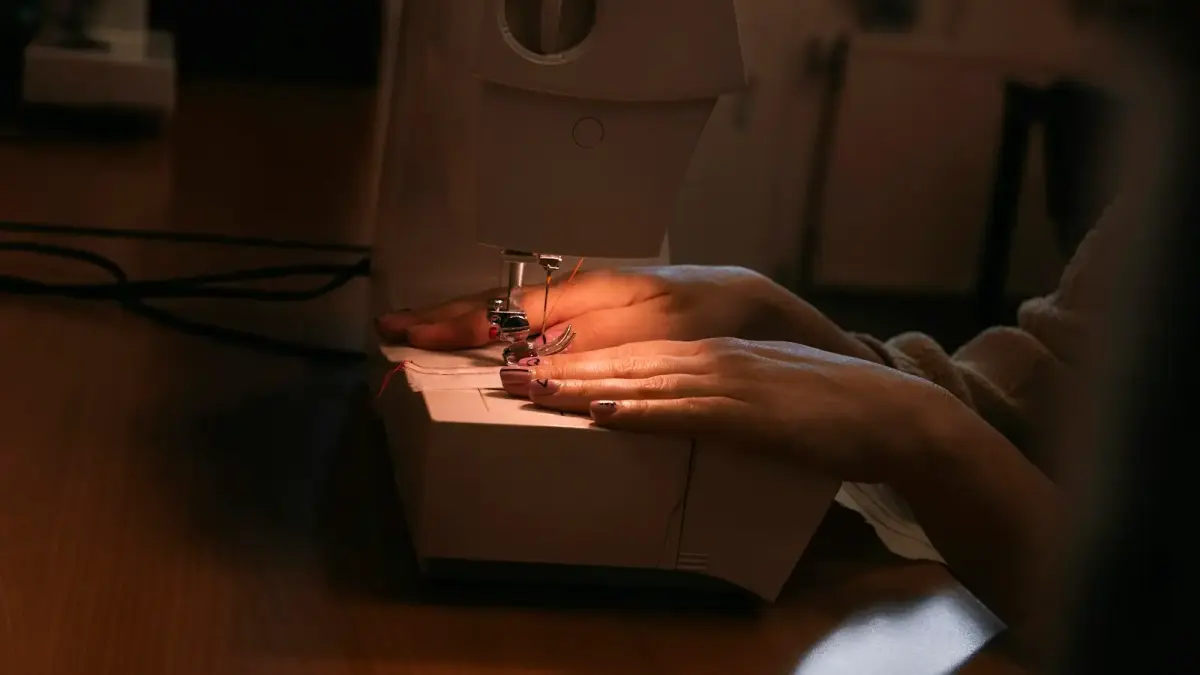
I mended a coat last week. A winter coat I’ve had for six years - the lining was pulling away from the hem. I could have taken it to a tailor. I could have bought a new one. Instead, I sat on the couch with my tin of supplies and spent forty minutes sewing it back together.
My stitches were imperfect. They always are. My mother’s were better.
But perfection was never the point. The point was the sitting down. The point was the choosing to fix it. The point was the thread pulled through fabric by hands that learned the motion from hands that learned the motion from hands I never met.
I think about all the women doing this right now, tonight, somewhere in a quiet house. Sewing a button. Patching a seam. Fixing a tear that nobody else would have noticed.
They’re not saving money. They’re not being old-fashioned.
They’re keeping a vigil. They’re honoring a language of love that was spoken entirely through the hands - a language that says: I will not let this come apart. I will not throw this away. I was raised by someone who held things together, and I will hold things together too, even when the world tells me it’s easier to start over.
Your tin of needles is not junk. Your impulse to repair is not outdated.
It is the most tender thing you inherited. And every stitch is a conversation with a woman who loved you in the only way she knew how - by making sure that nothing in your world stayed broken if her hands could reach it.